 Add to Chrome
 Add to Firefox
 Add to Edge
Trust the AI, Doubt Yourself: The Effect of Urgency on Self-Confidence in Human-AI Interaction
Apr 08, 2026
Studies show that interactions with an AI system fosters trust in human users towards AI. An often overlooked element of such interaction dynamics is the (sense of) urgency when the human user is prompted by an AI agent, e.g., for advice or guidance. In this paper, we show that although the presence of urgency in human-AI interactions does not affect the trust in AI, it may be detrimental to the human user's self-confidence and self-efficacy. In the long run, the loss of confidence may lead to performance loss, suboptimal decisions, human errors, and ultimately, unsustainable AI systems. Our evidence comes from an experiment with 30 human participants. Our results indicate that users may feel more confident in their work when they are eased into the human-AI setup rather than exposed to it without preparation. We elaborate on the implications of this finding for software engineers and decision-makers.

AI Can Learn Scientific Taste
Mar 15, 2026Great scientists have strong judgement and foresight, closely tied to what we call scientific taste. Here, we use the term to refer to the capacity to judge and propose research ideas with high potential impact. However, most relative research focuses on improving an AI scientist's executive capability, while enhancing an AI's scientific taste remains underexplored. In this work, we propose Reinforcement Learning from Community Feedback (RLCF), a training paradigm that uses large-scale community signals as supervision, and formulate scientific taste learning as a preference modeling and alignment problem. For preference modeling, we train Scientific Judge on 700K field- and time-matched pairs of high- vs. low-citation papers to judge ideas. For preference alignment, using Scientific Judge as a reward model, we train a policy model, Scientific Thinker, to propose research ideas with high potential impact. Experiments show Scientific Judge outperforms SOTA LLMs (e.g., GPT-5.2, Gemini 3 Pro) and generalizes to future-year test, unseen fields, and peer-review preference. Furthermore, Scientific Thinker proposes research ideas with higher potential impact than baselines. Our findings show that AI can learn scientific taste, marking a key step toward reaching human-level AI scientists.
Developing AI Agents with Simulated Data: Why, what, and how?
Feb 17, 2026As insufficient data volume and quality remain the key impediments to the adoption of modern subsymbolic AI, techniques of synthetic data generation are in high demand. Simulation offers an apt, systematic approach to generating diverse synthetic data. This chapter introduces the reader to the key concepts, benefits, and challenges of simulation-based synthetic data generation for AI training purposes, and to a reference framework to describe, design, and analyze digital twin-based AI simulation solutions.
Prism: Spectral-Aware Block-Sparse Attention
Feb 09, 2026Block-sparse attention is promising for accelerating long-context LLM pre-filling, yet identifying relevant blocks efficiently remains a bottleneck. Existing methods typically employ coarse-grained attention as a proxy for block importance estimation, but often resort to expensive token-level searching or scoring, resulting in significant selection overhead. In this work, we trace the inaccuracy of standard coarse-grained attention via mean pooling to a theoretical root cause: the interaction between mean pooling and Rotary Positional Embeddings (RoPE). We prove that mean pooling acts as a low-pass filter that induces destructive interference in high-frequency dimensions, effectively creating a "blind spot" for local positional information (e.g., slash patterns). To address this, we introduce Prism, a training-free spectral-aware approach that decomposes block selection into high-frequency and low-frequency branches. By applying energy-based temperature calibration, Prism restores the attenuated positional signals directly from pooled representations, enabling block importance estimation using purely block-level operations, thereby improving efficiency. Extensive evaluations confirm that Prism maintains accuracy parity with full attention while delivering up to $\mathbf{5.1\times}$ speedup.
FourierSampler: Unlocking Non-Autoregressive Potential in Diffusion Language Models via Frequency-Guided Generation
Jan 30, 2026Despite the non-autoregressive potential of diffusion language models (dLLMs), existing decoding strategies demonstrate positional bias, failing to fully unlock the potential of arbitrary generation. In this work, we delve into the inherent spectral characteristics of dLLMs and present the first frequency-domain analysis showing that low-frequency components in hidden states primarily encode global structural information and long-range dependencies, while high-frequency components are responsible for characterizing local details. Based on this observation, we propose FourierSampler, which leverages a frequency-domain sliding window mechanism to dynamically guide the model to achieve a "structure-to-detail" generation. FourierSampler outperforms other inference enhancement strategies on LLADA and SDAR, achieving relative improvements of 20.4% on LLaDA1.5-8B and 16.0% on LLaDA-8B-Instruct. It notably surpasses similarly sized autoregressive models like Llama3.1-8B-Instruct.
MrRoPE: Mixed-radix Rotary Position Embedding
Jan 28, 2026Rotary Position Embedding (RoPE)-extension refers to modifying or generalizing the Rotary Position Embedding scheme to handle longer sequences than those encountered during pre-training. However, current extension strategies are highly diverse and lack a unified theoretical foundation. In this paper, we propose MrRoPE (Mixed-radix RoPE), a generalized encoding formulation based on a radix system conversion perspective, which elegantly unifies various RoPE-extension approaches as distinct radix conversion strategies. Based on this theory, we introduce two training-free extensions, MrRoPE-Uni and MrRoPE-Pro, which leverage uniform and progressive radix conversion strategies, respectively, to achieve 'train short, test long' generalization. Without fine-tuning, MrRoPE-Pro sustains over 85% recall in the 128K-context Needle-in-a-Haystack test and achieves more than double YaRN's accuracy on Infinite-Bench retrieval and dialogue subsets. Theoretical analysis confirms that MrRoPE-Pro effectively raises the upper bound of RoPE's attainable encoding length, which further validates the reliability and utility of our theory and methodology.
DiRL: An Efficient Post-Training Framework for Diffusion Language Models
Dec 23, 2025Diffusion Language Models (dLLMs) have emerged as promising alternatives to Auto-Regressive (AR) models. While recent efforts have validated their pre-training potential and accelerated inference speeds, the post-training landscape for dLLMs remains underdeveloped. Existing methods suffer from computational inefficiency and objective mismatches between training and inference, severely limiting performance on complex reasoning tasks such as mathematics. To address this, we introduce DiRL, an efficient post-training framework that tightly integrates FlexAttention-accelerated blockwise training with LMDeploy-optimized inference. This architecture enables a streamlined online model update loop, facilitating efficient two-stage post-training (Supervised Fine-Tuning followed by Reinforcement Learning). Building on this framework, we propose DiPO, the first unbiased Group Relative Policy Optimization (GRPO) implementation tailored for dLLMs. We validate our approach by training DiRL-8B-Instruct on high-quality math data. Our model achieves state-of-the-art math performance among dLLMs and surpasses comparable models in the Qwen2.5 series on several benchmarks.
Beyond Real: Imaginary Extension of Rotary Position Embeddings for Long-Context LLMs
Dec 08, 2025Rotary Position Embeddings (RoPE) have become a standard for encoding sequence order in Large Language Models (LLMs) by applying rotations to query and key vectors in the complex plane. Standard implementations, however, utilize only the real component of the complex-valued dot product for attention score calculation. This simplification discards the imaginary component, which contains valuable phase information, leading to a potential loss of relational details crucial for modeling long-context dependencies. In this paper, we propose an extension that re-incorporates this discarded imaginary component. Our method leverages the full complex-valued representation to create a dual-component attention score. We theoretically and empirically demonstrate that this approach enhances the modeling of long-context dependencies by preserving more positional information. Furthermore, evaluations on a suite of long-context language modeling benchmarks show that our method consistently improves performance over the standard RoPE, with the benefits becoming more significant as context length increases. The code is available at https://github.com/OpenMOSS/rope_pp.
LongLLaDA: Unlocking Long Context Capabilities in Diffusion LLMs
Jun 17, 2025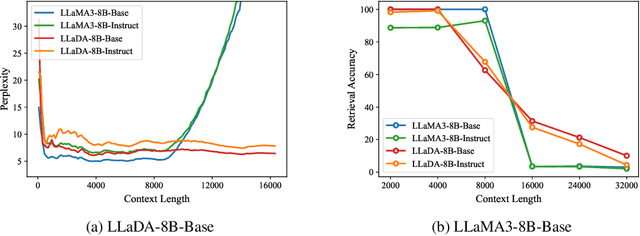
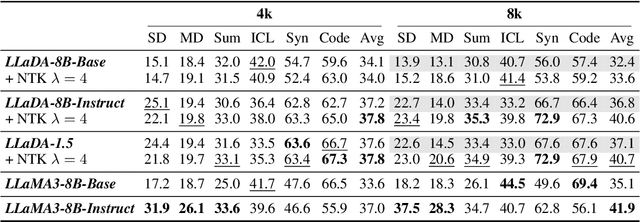
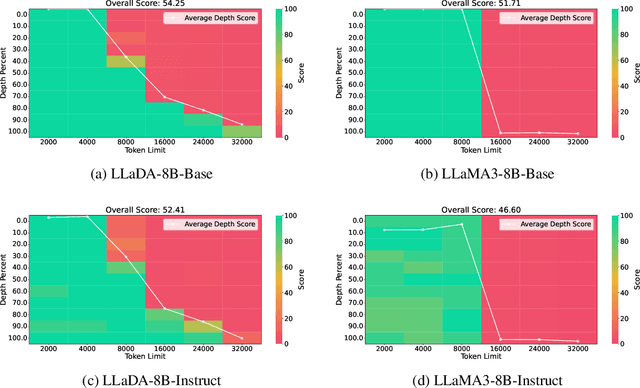
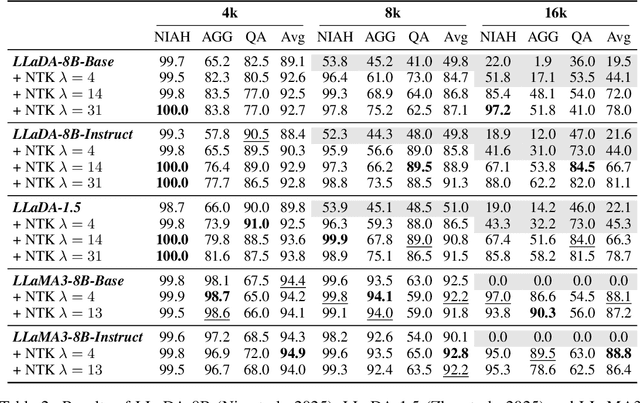
Large Language Diffusion Models, or diffusion LLMs, have emerged as a significant focus in NLP research, with substantial effort directed toward understanding their scalability and downstream task performance. However, their long-context capabilities remain unexplored, lacking systematic analysis or methods for context extension. In this work, we present the first systematic investigation comparing the long-context performance of diffusion LLMs and traditional auto-regressive LLMs. We first identify a unique characteristic of diffusion LLMs, unlike auto-regressive LLMs, they maintain remarkably \textbf{\textit{stable perplexity}} during direct context extrapolation. Furthermore, where auto-regressive models fail outright during the Needle-In-A-Haystack task with context exceeding their pretrained length, we discover diffusion LLMs exhibit a distinct \textbf{\textit{local perception}} phenomenon, enabling successful retrieval from recent context segments. We explain both phenomena through the lens of Rotary Position Embedding (RoPE) scaling theory. Building on these observations, we propose LongLLaDA, a training-free method that integrates LLaDA with the NTK-based RoPE extrapolation. Our results validate that established extrapolation scaling laws remain effective for extending the context windows of diffusion LLMs. Furthermore, we identify long-context tasks where diffusion LLMs outperform auto-regressive LLMs and others where they fall short. Consequently, this study establishes the first context extrapolation method for diffusion LLMs while providing essential theoretical insights and empirical benchmarks critical for advancing future research on long-context diffusion LLMs.
Beyond Homogeneous Attention: Memory-Efficient LLMs via Fourier-Approximated KV Cache
Jun 13, 2025Large Language Models struggle with memory demands from the growing Key-Value (KV) cache as context lengths increase. Existing compression methods homogenize head dimensions or rely on attention-guided token pruning, often sacrificing accuracy or introducing computational overhead. We propose FourierAttention, a training-free framework that exploits the heterogeneous roles of transformer head dimensions: lower dimensions prioritize local context, while upper ones capture long-range dependencies. By projecting the long-context-insensitive dimensions onto orthogonal Fourier bases, FourierAttention approximates their temporal evolution with fixed-length spectral coefficients. Evaluations on LLaMA models show that FourierAttention achieves the best long-context accuracy on LongBench and Needle-In-A-Haystack (NIAH). Besides, a custom Triton kernel, FlashFourierAttention, is designed to optimize memory via streamlined read-write operations, enabling efficient deployment without performance compromise.